The Air Canada case: why your chatbot must be able to say "I do not know"
Your chatbot must be able to say "I do not know" because, if it makes up an answer, your business is the one held responsible. That is what a tribunal in British Columbia, Canada, made clear in February 2024: Air Canada's chatbot gave a customer a condition that did not exist, and the airline had to compensate the customer. A good chatbot answers only with the real information of the business, admits what it does not know and passes anything that commits the business to a person.
What happened with the Air Canada chatbot
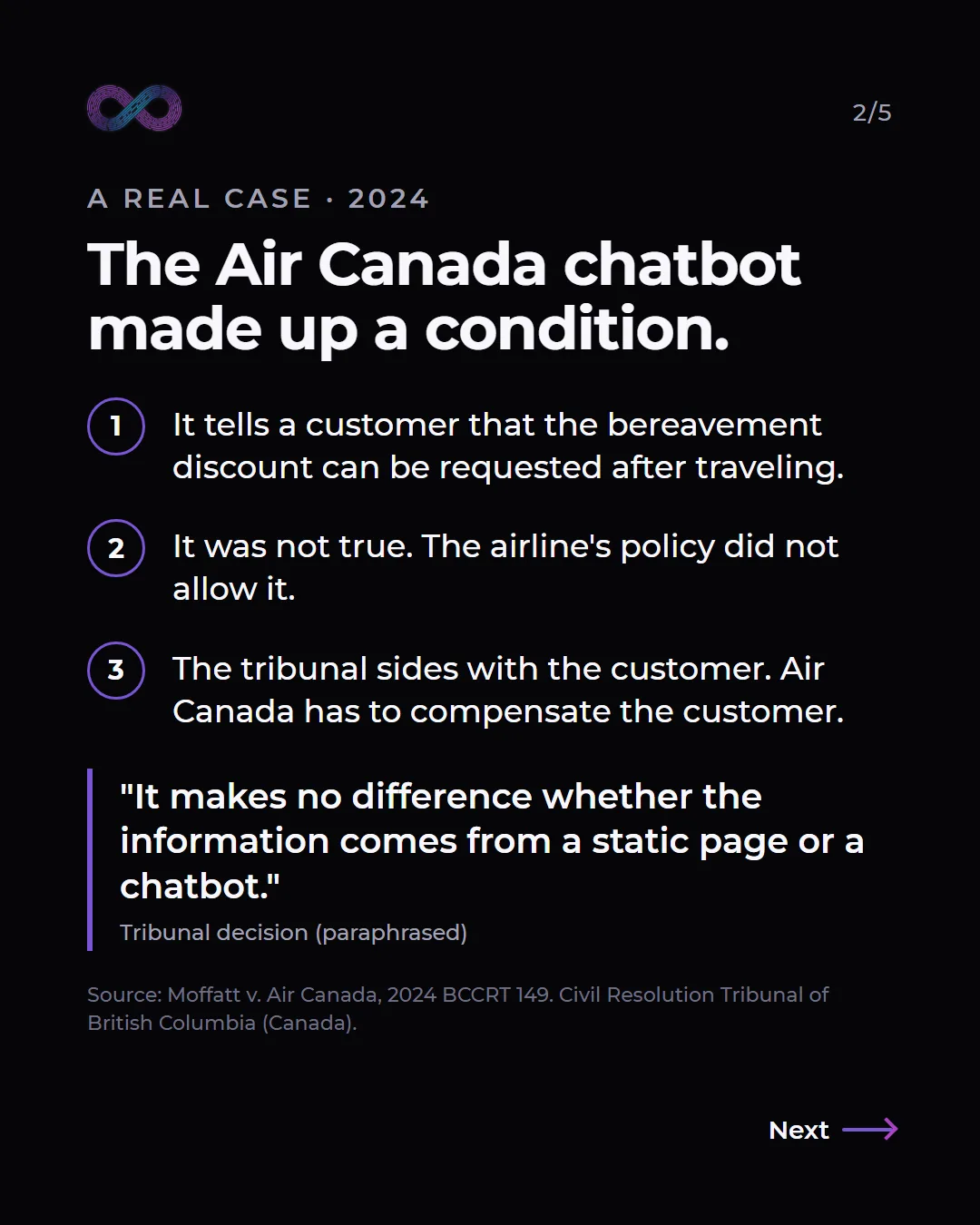
A customer asked the chatbot on the Air Canada website about the reduced fare for people traveling because a family member has died. The chatbot replied that the reduction could be requested after traveling, within 90 days of the ticket being issued. The customer bought the ticket relying on that answer and, after the trip, asked for the reduction.
It was not true. The airline's policy did not allow the request after travel, and Air Canada refused it. The customer took the claim to the Civil Resolution Tribunal of British Columbia.
What the tribunal said
Air Canada went as far as arguing that, in practice, the chatbot was responsible for its own actions. The tribunal did not accept that. Its reasoning was simple: the company is responsible for all the information on its website, and it makes no difference whether that information comes from a page or from a chatbot.
The airline had to pay the customer the fare difference, plus interest and tribunal fees: 812.02 Canadian dollars in total. One point is worth making clear: the tribunal did not order the airline to apply the invented condition. It found the airline liable for negligent misrepresentation, that is, for giving misleading information through carelessness.
Why it matters even though the amount is small
A little over 800 dollars will not sink an airline. What really weighs is everything else: a customer who trusts an answer that nobody at the company actually gave, a claim that never needed to exist, and the name of the brand in the news.
For a small business, the proportions change. A chatbot that promises an impossible delivery time, a price that is wrong or a refund that does not apply creates exactly the same problem, and the same person who handles everything else has to sort it out.
Why a chatbot makes up an answer
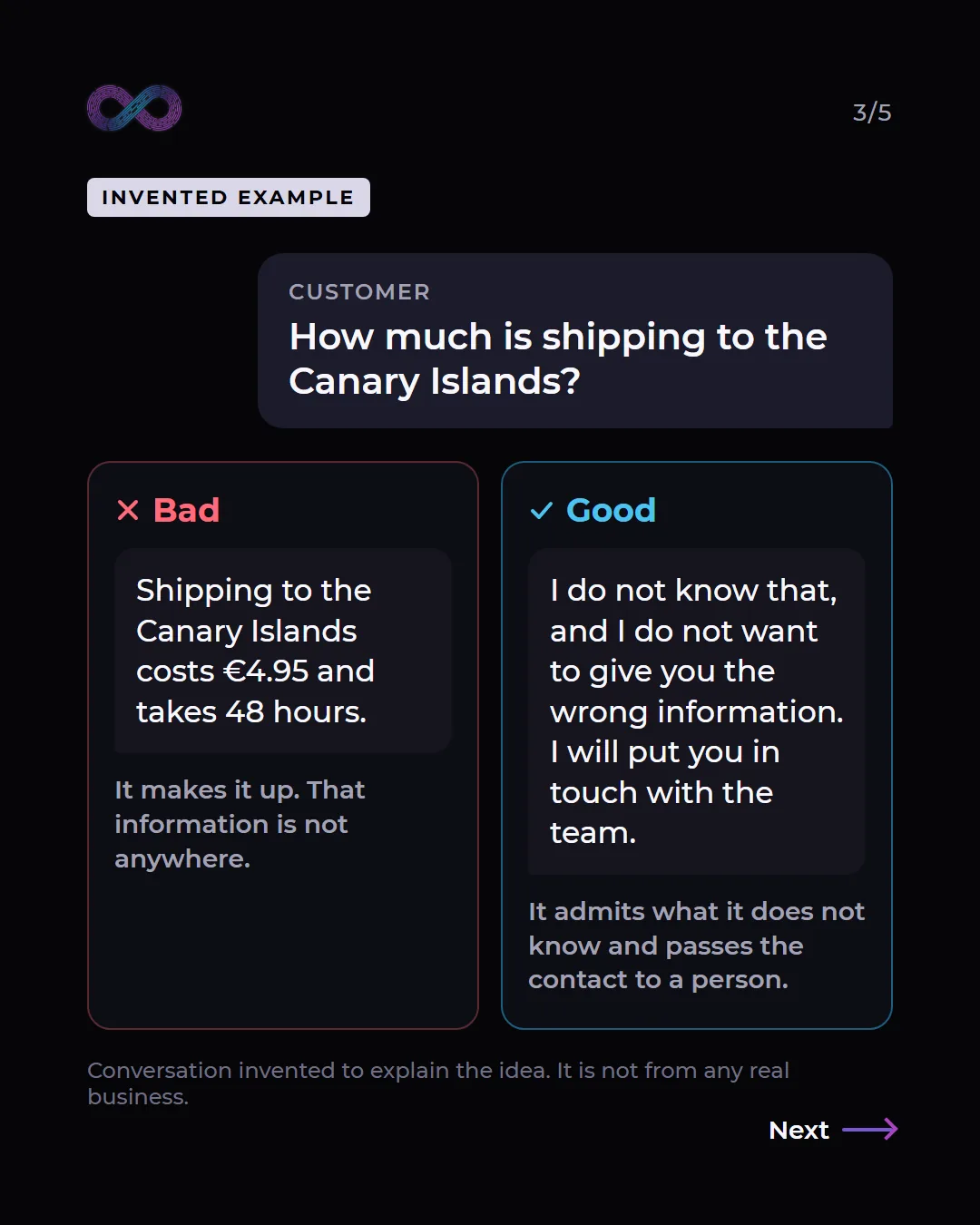
A chatbot built on a language model does not look up a record to answer: it writes the most likely response. If the information is not within its reach, it fills the gap with something that sounds reasonable, with the same confidence as a true fact. We explain this in more detail in why AI makes things up.
That is why the problem is not solved with a "smarter" chatbot. It is solved by deciding where the answers come from and what the chatbot does when it does not have them.
The three things a good chatbot must do
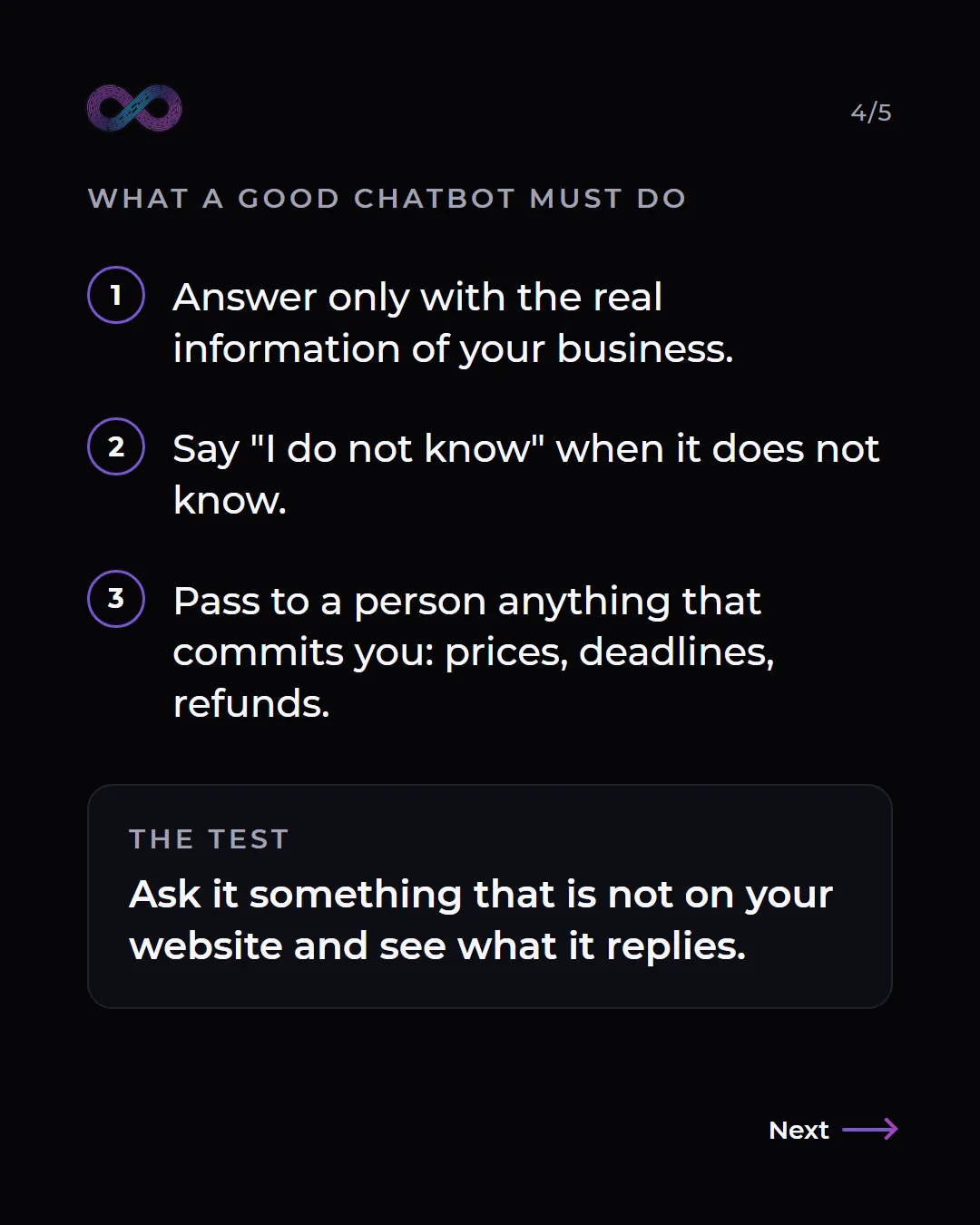
- Answer only with the real information of the business: the website, the catalog, the terms. If it is not there, the chatbot does not say it.
- Admit what it does not know, and say so clearly instead of filling the gap.
- Pass to a person anything that commits the business: firm prices, deadlines, refunds and exceptions.
The third one is the one most often forgotten. A chatbot can know the returns policy in detail and still should not approve a return outside the deadline: that is an exception, and exceptions are decided by the business. The right thing is for it to collect the case, explain what happens next and pass it to a person with all the context, so the customer does not have to tell the whole story again.
A good chatbot is not the one that knows everything. It is the one that knows where its knowledge ends.
How we apply it in the assistant on our website
This is the principle behind the chat assistant on infinyai.com. It can only state what is on our website; if someone asks about something that is not there, it says it does not know instead of making it up. It also does not give prices or timelines for custom projects, because those are agreed with a person before any work starts.
It is the same principle we propose for a chatbot in any business: first, what information it can use; then, what it should do when that information is missing.
A test you can run today
If you already have a chatbot on your website, ask it a question whose answer is not on your website and see what it replies. For example, the delivery time to a place you do not ship to, or a discount that does not exist.
If it replies with a specific figure, it is making it up, and it is worth reviewing before it does so in front of a customer. If it says it does not know and offers to put you in touch with someone, it is on the right track.
Frequently asked questions
Is a company responsible for what its chatbot says?
In the Air Canada case, the tribunal said yes: the company is responsible for all the information on its website, whether it comes from a page or from a chatbot. This is not legal advice, but the underlying idea is clear: what your chatbot says, your business says.
How much did Air Canada have to pay?
812.02 Canadian dollars: the fare difference, plus interest and tribunal fees.
How do I stop my chatbot from making up answers?
By making it answer only with the real information of your business, allowing it to say "I do not know" and having it pass to a person anything that commits you, such as prices, deadlines or refunds.
How can I check whether my chatbot makes things up?
Ask it something that is not on your website. If it gives a specific answer instead of admitting that it does not know, it is making it up.